
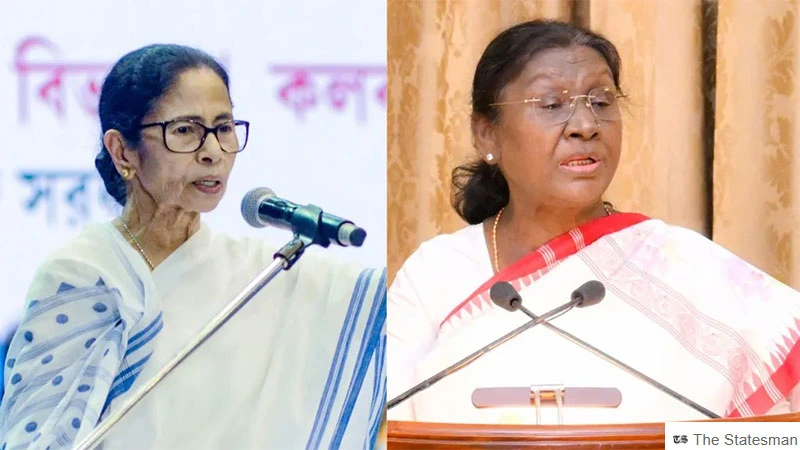
Mamata Snubs Murmu: Isn’t it an Audacity?
Mamata snubs Murmu – When this becomes headline grabbing, it is bound to erupt political rows. Indian politics often witnesses intense clashes between the Centre and states. However, some incidents go far beyond routine political disagreements.
The recent episode involving West Bengal Chief Minister Mamata Banerjee and President Droupadi Murmu has created exactly such a controversy.
When Mamata Banerjee allegedly snubbed the President during her visit to North Bengal, the issue quickly turned into a political storm. Moreover, the matter is not merely about protocol.
Instead, it raises deeper questions about governance, tribal development, and the political messaging ahead of the 2026 West Bengal Assembly election. More importantly, it is at a situation when there is a mere chance of Presidential Rule in the state.
Let us examine why this episode has triggered such a sharp reaction across the political spectrum.
The “Stop Now” Incident: Context Behind Mamata Banerjee’s Remark
In India’s political culture, protocol matters. When the President visits a state, the Chief Minister usually receives the President personally. If the Chief Minister cannot attend, a senior cabinet minister or top bureaucrat generally represents the state government.
However, during President Murmu’s visit to Siliguri, the situation was very different.
Reports indicate that:
- Chief Minister Mamata Banerjee did not receive the President.
- No senior cabinet minister was present either.
- Even the state’s top bureaucrats such as the Chief Secretary or DGP were absent.
- Instead, Siliguri Mayor Gautam Deb welcomed the President.
This unusual arrangement immediately sparked criticism from political observers and opposition leaders. Does Mamata Banerjee think West Bengal does belong to the Union of India?
For many critics, the issue is simple: how could a state government appear to ignore the President of India?
What Happened at the 9th International Santal Conference?
The controversy became sharper because of the nature of the event itself.
President Murmu attended the 9th International Santal Conference in Siliguri, a major gathering focused on the culture and development of the Santhal tribal community.
However, several unexpected developments occurred.
Venue Change Raised Questions
Initially, the event was supposed to take place in Bidhannagar in Siliguri. Later, the venue was shifted to Goshaipur.
The sudden change surprised many attendees and organizers.
Low Crowd Presence
Observers also noticed that the turnout at the conference was significantly lower than expected.
According to reports:
- Many invited guests did not receive security passes.
- Some participants allegedly faced obstruction while entering the venue.
- As a result, attendance remained much lower than anticipated.
For an international tribal conference, the thin crowd created an awkward atmosphere.
Political Fallout: Why the TMC-Murmu Friction Matters?
President Droupadi Murmu is widely known for her calm personality and measured public remarks. She rarely makes political comments.
Therefore, when she raised concerns about tribal development, her remarks drew considerable attention.
During the event, she highlighted the importance of improving the socio-economic conditions of tribal communities.
More importantly, she made an emotional remark: “I am also a daughter of Bengal.”
This statement carried multiple layers of meaning.
On the surface, it reflected her emotional connection with the region.
At another level, it hinted at concerns regarding the development priorities of tribal areas.
For many political observers, the remark sounded like a subtle yet powerful message.
Is the Tribal Identity Factor Important in This Issue?
Absolutely. The tribal dimension makes this controversy even more sensitive.
President Droupadi Murmu belongs to the Santhal community, one of the largest tribal groups in eastern India.
Santhals have a strong sense of ethnic identity and cultural pride. Therefore, any perceived disrespect toward a tribal leader can quickly become a major political issue.
This factor becomes particularly significant in West Bengal because tribal voters influence several key electoral regions.
These include:
- Jhargram
- Bankura
- Purulia
- Parts of Midnapore
- Several constituencies in North Bengal
As a result, political parties closely monitor sentiments within tribal communities.
How Did Narendra Modi React?
The controversy quickly escalated after Prime Minister Narendra Modi criticized the incident strongly.
Speaking ahead of a major rally at Brigade Parade Ground, Modi described the situation as deeply troubling.
He reportedly said:
“This is shameful and unprecedented. Everyone who believes in democracy and the empowerment of tribal communities is deeply shocked.”
This strong statement indicates that the issue may become a major political talking point.
The Prime Minister is scheduled to address a massive rally in Kolkata on March 14, 2026, and political analysts believe this controversy will likely feature prominently in his speech.
Reactions from the BJP and Opposition Leaders
The Bharatiya Janata Party has long tried to expand its support among tribal communities across eastern India.
In fact, the party made a historic move when it supported Droupadi Murmu as the presidential candidate in 2022.
At that time, Mamata Banerjee tried to build a united opposition front to field an alternative candidate against Murmu.
She reportedly contacted several opposition leaders across India in search of a consensus candidate.
Eventually, Murmu won the election comfortably and became India’s first tribal woman President.
Because of this history, the current controversy carries additional political weight.
How Has Mamata Banerjee Responded?
Chief Minister Mamata Banerjee has strongly defended her government.
She argued that:
- The state government has done significant work for tribal welfare.
- The criticism is politically motivated.
- The issue is being unnecessarily turned into a BJP vs TMC narrative.
Mamata also suggested that political forces are trying to create confusion among tribal voters ahead of the elections.
At times, she has even accused President Murmu of being influenced by the BJP narrative.
According to Mamata, the opposition frequently tries to portray administrative issues as political conspiracies.
What Do Past Election Results Reveal About Tribal Votes?
The political importance of tribal communities in West Bengal has fluctuated in recent years.
2019 Lok Sabha Election
In the 2019 general election:
- The BJP performed strongly in many tribal-dominated regions.
- The party won several seats where tribal votes played a decisive role.
2021 Assembly Election and 2024 Lok Sabha Election
However, the situation changed in the state assembly election and the subsequent Lok Sabha Election.
The All India Trinamool Congress regained control in multiple tribal regions such as:
- Bankura
- Jhargram
- Midnapore
In the most recent national election, the competition remained intense, with both parties trying to consolidate tribal support.
Therefore, the current controversy could influence political narratives in these regions.
Could This Become a Major 2026 Election Issue?
With the 2026 West Bengal Assembly election approaching, every political signal matters.
This controversy contains several elements that make it politically explosive:
- Alleged protocol violation involving the President
- Tribal identity and representation
- Development concerns in tribal areas
- Centre vs state confrontation
Political strategists believe that opposition parties, especially the BJP, may highlight this episode during campaign speeches.
If tribal communities perceive disrespect or neglect, it could reshape electoral equations in several constituencies.
Conclusion
Political disagreements are common in a vibrant democracy. However, controversies involving the President of India rarely occur.
The alleged snub to President Droupadi Murmu has therefore generated strong reactions across the political spectrum.
For some, it reflects the deepening Centre-state tensions in West Bengal politics. For others, it raises serious questions about tribal development and respect for constitutional offices.
As the 2026 Assembly election approaches, this issue may continue to resonate in political debates.
The bigger question now remains:
Will this controversy fade away quickly, or will it reshape the political narrative in West Bengal?
Key Takeaways
- President Droupadi Murmu attended the 9th International Santal Conference in Siliguri.
- Chief Minister Mamata Banerjee did not personally receive the President.
- The absence of senior officials triggered criticism over protocol.
- The event saw a surprisingly low turnout and venue change controversy.
- Prime Minister Narendra Modi strongly condemned the incident.
- Tribal identity and Santhal community pride add a sensitive dimension to the issue.
- The controversy may become a major talking point before the 2026 West Bengal election.
People Also Ask
Why is Mamata Banerjee facing criticism over President Droupadi Murmu’s visit?
West Bengal Chief Minister Mamata Banerjee faced criticism because she did not personally receive President Droupadi Murmu during her visit to Siliguri. Traditionally, the Chief Minister or a senior minister receives the President. The absence of top state officials triggered allegations of a protocol breach and political disrespect.
What was the 9th International Santal Conference in Siliguri?
The 9th International Santal Conference is a major cultural and social gathering of the Santhal tribal community. The event highlights tribal heritage, language, and development issues. President Droupadi Murmu attended the conference in Siliguri, making the event politically significant because she herself belongs to the Santhal community.
Why did President Droupadi Murmu say she is a “daughter of Bengal”?
During her speech, President Droupadi Murmu said she is also a “daughter of Bengal.” The remark reflected her emotional connection with the region and the Santhal community. At the same time, many observers interpreted the statement as a subtle reminder about the importance of tribal development.
What did Prime Minister Narendra Modi say about the controversy?
Prime Minister Narendra Modi strongly criticized the incident. He described it as “shameful and unprecedented,” saying that people who believe in democracy and tribal empowerment were shocked. His comments suggest that the issue may become a political talking point in upcoming election campaigns.
Why are tribal votes important in West Bengal politics?
Tribal voters influence several districts in West Bengal, including Jhargram, Bankura, Purulia, and parts of Midnapore and North Bengal. These areas can decide multiple assembly seats. Therefore, political parties like the All India Trinamool Congress and the BJP actively try to win tribal support.
Did Mamata Banerjee oppose Droupadi Murmu’s presidential candidature?
Yes. When the BJP nominated Droupadi Murmu for President in 2022, Mamata Banerjee tried to unite opposition parties to field a joint candidate. Despite those efforts, Murmu eventually won the presidential election with broad support.
Could this controversy affect the 2026 West Bengal Assembly election?
Political analysts believe the controversy could influence the 2026 West Bengal Assembly election. Issues involving the President, tribal identity, and Centre–state relations often attract strong public attention. Therefore, opposition parties may use the incident to question the state government’s approach toward tribal communities.
Why was the Santal Conference crowd reportedly smaller than expected?
Reports suggest the turnout was lower than expected because many invited guests did not receive security passes on time. Some participants also claimed they faced restrictions while entering the venue. As a result, attendance at the international tribal conference remained limited.