What Is Mamata’s New PPP Scam Model In West Bengal?
On May 22, 2026, the popular Bengali news channel
ABP Ananda aired a startling revelation that completely redefined a well-known administrative acronym. Today, citizens are learning about
Mamata’s New PPP Scam Model, which stands for a notorious, illegal alliance between:
- Politician – Policy power and protection
- Police – Administrative enforcement
- Promoter – Financial and real estate execution
For decades, the public understood
PPP as Public-Private Partnership, a legitimate system used to build bridges, roads, and government infrastructure. However, recent developments have given this acronym a dark twist in West Bengal.
This freshly coined term exposes a deeply entrenched syndicate operating right under the nose of the state administration.
Instead of building public infrastructure, this new triad allegedly focuses on illegal financial gains, aggressive land grabbing, and multi-crore extortion rackets.
The revelation has shifted the state’s political discourse, focusing heavily on how
administrative machinery can be repurposed for localized exploitation.
Old vs New PPP Meaning
| Aspect |
Traditional PPP |
New PPP (Alleged) |
| Full Form |
Public Private Partnership |
Politician-Police-Promoter |
| Purpose |
Development projects |
Alleged nexus |
| Stakeholders |
Govt + Private firms |
Political + Police + Business |
| Public Benefit |
High (ideally) |
Highly Damagaing |
Who Are The Key Players Unveiled By The ED?
The Enforcement Directorate (ED) recently blew the lid off this system. According to an extensive
India Today Report on the Bengal Extortion Racket, the federal agency exposed a jaw-dropping network that shows exactly how the Politician-Police-Promoter triad functions on the ground.
Three high-profile names sit at the very center of this unfolding drama:
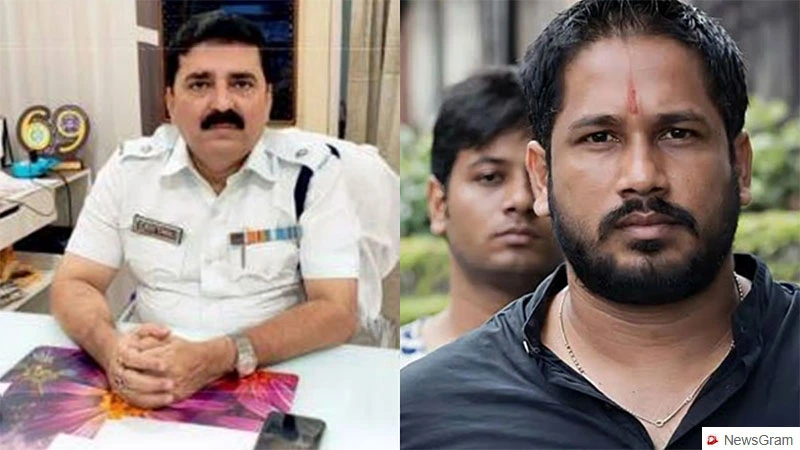
- Santanu Sinha Biswas: A highly influential former Deputy Commissioner (DCP) of the Kolkata Police and former Officer-in-Charge (OC) of Kalighat Police Station. The ED arrested him on May 14 after he allegedly failed to cooperate during questioning. Investigators claim his family constructed a palatial residence in Kandi, Murshidabad, in just five to six years using proceeds from corruption. Biswas allegedly used his administrative muscle to shield criminals and target innocent landowners. He is also alleged to be a close aid of Mamata Banerjee.
- Biswajit Poddar (alias Sona Pappu): A prominent real estate promoter based in Ballygunge and Kasba. Sona Pappu, who carries a history of over 15 criminal charges including violence, rioting, and Arms Act violations, was on the run for three months before being arrested by the ED on May 18. Investigators found over Rs. 2 crore in cash, property deeds, and firearms linked to his operations.
- Jay Kamdar: A powerful businessman and realtor from Behala. The ED tracked massive financial transactions between Poddar and Kamdar’s firms. Investigators claim Kamdar held massive clout with state police officials, showered them with luxury gifts, handled cross-border channels, and worked as the operational head behind the land syndicate.
The Breakdown of the Syndicate
| Syndicate Role |
Primary Actor |
Alleged Operational Method |
| The Police (Protector) |
Santanu Sinha Biswas (Ex-DCP) |
Used official position to halt complaints against promoters and intimidate local victims. |
| The Promoter (Executioner) |
Sona Pappu (Biswajit Poddar) |
Used criminal networks, bombs, and muscle power to grab land and force unfavorable deals. |
| The Financier (Money Trail) |
Jay Kamdar (Behala Realtor) |
Laundered money through business networks, managed funds, and distributed expensive gifts. |
Why Are ED And CBI Raids Continuing Post-Election?
For years, opposition leaders routinely claimed a specific bias. They argued that central agencies only launched raids right before elections.
According to this old narrative, the IT department, CBI, and ED acted merely as political tools. Opposition parties claimed these agencies squeezed them just before voters hit the polling booths.
However, a major paradigm shift is happening right now. The 2024 general elections are long gone, and we are now well into 2026.
Despite this quiet
post-election era, the
central agencies have not slowed down their pace. Instead,
they are launching aggressive raids across Kolkata, Murshidabad, Kasba, and Chakraberia. These actions prove that hard financial trails, rather than electoral calendars, now drive the entire investigation.
Consequently, the standard allegations of a
political vendetta are losing weight. Central teams are sustaining strong momentum well outside election seasons.
Moreover, the sheer volume of recovered cash, digital footprints, and firearms speaks for itself. As a result, critics can no longer easily dismiss these actions as mere political posturing.
Recent ED Activity Snapshot
| Date |
Event |
Key Focus |
| 14 May 2026 |
Arrest of Santanu Sinha Biswas |
Extortion & fraud |
| 19 May 2026 |
Arrest of Sona Pappu |
Land grab case |
| 22 May 2026 |
Multi-location raids |
Syndicate network |
Is The Era Of Obstructing Central Agencies Finally Over?
West Bengal has a turbulent history when it comes to central investigators facing local resistance. As documented in a comprehensive
Indian Express Report on the Sona Pappu Case, the public has previously witnessed unprecedented clashes between state machinery and federal agencies.
A History of Resistance: From the standoffs involving former police chief Rajeev Kumar to the violent ambushes on ED officials in Sandeshkhali by Sheikh Shahjahan’s supporters, central teams have routinely faced physical and legal barriers in Bengal.
In some of the most dramatic moments of the past,
Chief Minister Mamata Banerjee personally rushed to locations during central operations, such as intrusion to properties during raids on businessman Prateek Jain, accompanied by top-tier bureaucrats and police officers.
In addition, the state government frequently launched local FIRs against ED and CBI officers to disrupt their momentum, while withholding mandatory administrative sanctions required to prosecute corrupt government officials. There had been numerous court cases regarding these pending permissions.
Past Patterns
The Shifting Legal Landscape
| Past Resistance Tactics |
The Current Status (2026) |
| Physical blockades and localized violence against federal officers. |
High-security central deployment prevents local interference. |
| State-sponsored FIRs designed to legally harass ED/CBI agents. |
Strict judicial oversight from higher courts shields federal investigators. |
| Withholding official sanctions to protect corrupt bureaucrats. |
Active court interventions are clearing long-pending legal permissions. |
With these judicial interventions, federal teams no longer face old roadblocks. As a result, they move faster and act more firmly. Recently, the agency expanded its search to nine new locations.
Moreover, it targeted individuals like
Sub-Inspector Ruhil Amin Ali and Saurav Adhikari, the nephew of Santanu Sinha Biswas. This clearly shows that the old protective cover is breaking down.
Meanwhile, when investigators reached Biswas’s locked house in Murshidabad, they did not step back. Instead, they took direct action. They broke open the lock and entered the premises. Then, they carried out their investigation without delay.
Will The Investigation Ever Reach The True Heads Of Corruption?
As the
ED unearths complex networks involving land syndicates and financial channels managed by Jay Kamdar, a massive question remains on everyone’s mind: Will this multi-layered investigation stop at the mid-level executors, or will it successfully reach the ultimate masterminds of the system?
While arresting a Deputy Commissioner of Police and a powerful promoter represents progress, citizens recognize that a syndicate this vast cannot survive without high-level
political patronage.
For decades, the true architects of large-scale institutional corruption in West Bengal have managed to stay behind a wall of plausible deniability, letting lower-level operatives take the fall.
The big question remains whether the law will penetrate this protective layer.
Can West Bengal Ever Restore The True Rule Of Law?
The people of West Bengal do not want biased political harassment. Similarly, they do not support vendetta politics. Instead, the public demands the absolute restoration of the rule of law.
The law should identify, try, and punish offenders strictly based on their crimes. Furthermore, it must completely ignore their political position, societal status, or institutional influence. Unfortunately,
unbiased justice has become a rare sight in Bengal’s modern history.
However, a historical precedent does exist. Years ago, a courageous police officer from Bengal named
Upen Biswas showed the entire nation how to dismantle deep-rooted political corruption. As a brilliant investigator in the CBI, Upen Biswas relentlessly pursued the infamous
Fodder Scam.
Consequently, he successfully built an airtight case. His efforts eventually led to the arrest and conviction of
Lalu Prasad Yadav, who was a sitting Chief Minister and an incredibly powerful politician at the time.
Biswas proved that no individual, no matter how powerful, is above the constitution.
Therefore, citizens ask a valid question today: Can we expect this same determination right now?
The exposure of
Mamata’s New PPP Scam Model marks a critical turning point for West Bengal’s socio-political environment.
By breaking down the intricate web spun by
Santanu Sinha Biswas, Sona Pappu, and Jay Kamdar,
central agencies have demonstrated a clear shift. They have proven that post-election administrative cleanups are entirely possible.
To witness the visual footprint of these crackdowns, including the palatial properties under scrutiny, you can watch this
TV9 Bangla Report on Santanu Sinha Biswas’s Arrest.
Ultimately, the long-term restoration of public faith depends heavily on the next steps.
People want to see whether these central investigations stop at the execution level or fearlessly march to the absolute head of the corruption syndicate.
Key Takeaways
- Mamata’s New PPP Scam Model redefines PPP in politics
- ED investigations triggered the debate
- Santanu Sinha Biswas, Sona Pappu, Jay Kamdar are central figures
- Arrests and raids confirm active probes
- Post-election raids weaken political timing arguments
- Past resistance to agencies was significant
- Current trend shows reduced obstruction
- Top-level accountability remains uncertain
- Public demands fairness, not vendetta
- Final outcome depends on persistency, consistency and courts
Frequently Asked Questions About Mamata’s New PPP Scam Model
What exactly is Mamata’s New PPP Scam Model in West Bengal?
Historically, people understood the acronym PPP as Public-Private Partnership. However, a major revelation on ABP Ananda completely redefined the term. Today, it represents a deep-rooted, illegal alliance between the
Politician, Police, and Promoter. This freshly exposed triad allegedly functions as an organized land-grabbing syndicate. Furthermore, it utilizes state machinery to run highly coordinated extortion rackets across West Bengal.
Who is Santanu Sinha Biswas and how is he involved?
Santanu Sinha Biswas is a highly influential, recently terminated Deputy Commissioner (DCP) of the Kolkata Police. The Enforcement Directorate (ED) arrested him after an intense 11-hour interrogation session. According to investigators, Biswas actively patronized notorious local criminals. Instead of enforcing the law, he allegedly used his administrative power to halt public complaints and shield illegal real estate developers.
Why did the ED arrest the real estate promoter Sona Pappu?
Biswajit Poddar, famously known as Sona Pappu, is a controversial real estate developer from Ballygunge. He previously evaded law enforcement agencies for over three months. Consequently, the ED arrested him after he finally walked into their office. Pappu currently faces at least 15 serious criminal charges. These cases include active land grabbing, rioting, attempted murder, and multiple severe violations under the Arms Act.
What role did businessman Jay Kamdar play in the syndicate?
Jay Kamdar serves as the Managing Director of Sun Enterprise. The ED arrested him after tracking massive financial irregularities. Investigators allege that Kamdar ran extensive international and domestic hawala channels worth over Rs. 1,100 crore through shell companies. Furthermore, he misused his enormous clout by distributing expensive gifts to police officials in exchange for illicit land favors.
Why are central agency raids continuing even after the elections?
Previously, regional parties claimed that federal agencies only conducted searches right before voting days. However, the current actions in 2026 prove otherwise. The central teams are sustaining intense momentum deep into the post-election era. This continuous action demonstrates that undeniable financial trails, rather than temporary political agendas, now dictate the course of justice.