
IPAC & SIR update: High-Stakes Supreme Court Deadlock Continues
As West Bengal hurtles toward the 2026 Assembly elections, the legal landscape remains in a state of intense friction. Today’s Supreme Court proceedings offered a critical IPAC & SIR update, highlighting a dual-front struggle involving investigative autonomy and electoral integrity. In the I-PAC case, the Bench grappled with the unprecedented question of whether the Enforcement Directorate (ED) can invoke Article 32 when a State head allegedly obstructs a federal raid.
Simultaneously, the SIR (Special Intensive Revision) process remains under the judicial scanner as the Election Commission released the first supplementary voter list, attempting to clear the massive backlog of 60 lakh names currently pending adjudication. With no drastic orders passed today, all eyes remain on the judiciary to resolve this constitutional “vacuum” before the state heads to the polls.
What Happened in Two High-Profile Supreme Court Cases on the Same Day?
On the same day, two high-profile cases came up in the Supreme Court of India. Naturally, excitement spread everywhere. As a result, many people felt a surge of adrenaline and waited eagerly for updates.
Why Were People So Excited About the IPAC & SIR Cases?
Everyone was asking one big question was what will happen in the IPAC & SIR cases? The reason is simple. The outcome could impact the political future of the state’s Chief Minister. Therefore, the tension and curiosity reached the hilt today.
At the same time, attention also shifted to the voter list revision case. People wanted to know, how will the judicial officers resolve the large number of pending names? Moreover, another important question emerged.
Many closely watched whether elections would take place on schedule. On the other hand, some wondered if they would happen under President’s Rule instead.
What Was the Final Outcome of the Day?
However, by the end of the day, the result disappointed many. Despite the high expectations, the outcome turned out to be underwhelming, almost like a mountain giving birth to a mouse.
What was the Center of Debate in the IPAC Case?
In the IPAC case, the discussion mainly focused on Article 32 of the Indian Constitution. This article allows citizens to directly approach the Supreme Court of India for the protection of fundamental rights. Therefore, it became a key issue during the hearing.
Another major question came up, can the Enforcement Directorate file a case related to fundamental rights without the Deputy Director being present?
As a result, lawyers from both sides argued intensely on this issue.
During the arguments, Justice Mishra made a strong remark. He clearly stated that the court would keep both elections and criminals away from each other. Because of this, his comment quickly drew attention.
At one point, the court observed that the Chief Minister may not have made the right decision that day. However, this was only an observation, not a final judgment.
Finally, the court fixed the next hearing date. The next date of hearing of the case will now be on April 14.
What is the update in the Special Intensive Revision (SIR) Case?
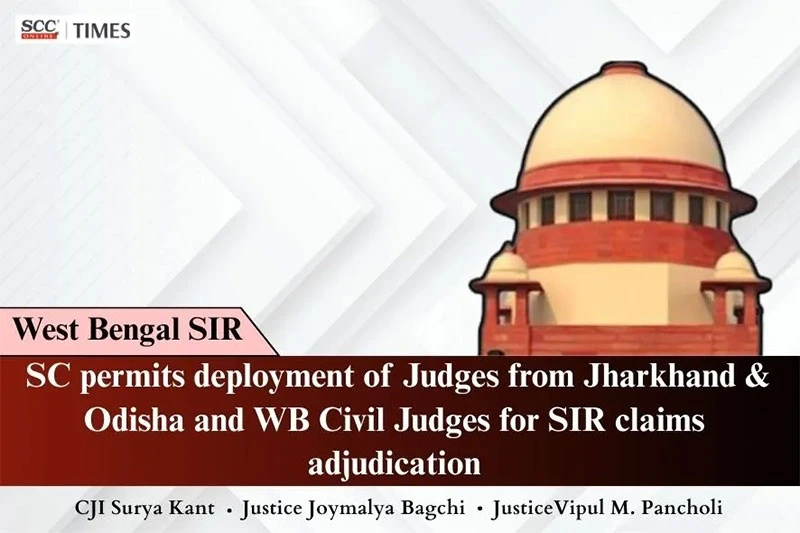
The Calcutta High Court has submitted the status report in the SIR case to the Supreme Court of India. According to the report, around 2.7 million (27 lakh) names have already been settled. However, nearly 3.3 million (33 lakh) names are still pending. As a result, concerns remain high as the West Bengal Assembly Election 2026 is approaching.
During the hearing, the judges openly stated that significant pressure burdens judicial officers. Moreover, almost everyone in the courtroom agreed with this observation. Therefore, the situation appears quite intense.
The Calcutta High Court Chief Justice is regularly updating the Supreme Court.
In addition, the Chief Justice of Calcutta High Court has already formed 19 appellate tribunals to handle disputes.
This step aims to speed up the resolution process.
Interestingly, the court noted that no other state in India has faced such problems with SIR. Although, in many states, the SIR Process has excluded a large number of names, the scale of complications here is different.
Lawyers requested an extension for freezing the voter roll as Bengal Elections 2026 is around the corner. However, the judges responded that they will consider this request later. So, we could not arrive at a final decision as yet.
Finally, the Supreme Court has scheduled the next hearing in the SIR case on April 1.
Will Voters’ Rights Be Protected?
There was an appeal from Bikahs Bhattacharya on behalf of the key petitioner. In reply, the judges clearly emphasized one key point that the democratic rights must be protected. In particular, they stressed that every voter’s rights should remain secure throughout the process.
What Questions Still Remain After the Supreme Court Hearings?
With dues respect and trust to the Indian Judiciary and the honourable judges, let us raise a few questions:
- Did the Chief Minister Commit Any Offence in the IPAC Case?
- Did Top Police and Bureaucrats Break the Law in the IPAC Case?
- Is It Mathematically Possible to Finish the Remaining Work of SIR within April 6?
- How Will Appeals Be Handled for Last-Minute Exclusions?
- What If Election Delays Create a Constitutional Crisis before Bengal Assembly Elections?
Is There Any Backup Plan or SOP?
Finally, people are asking, does the system have a Plan B? Or is there any clear Standard Operating Procedure (SOP) in place? As of now, no detailed roadmap has been publicly explained.
Above All, while the hearings answered some points, many critical questions are still open. Therefore, all eyes remain on the upcoming hearings for clearer direction.
Did Today’s Supreme Court Hearing Answer Key Questions?
In simple terms, before today’s hearing, people in West Bengal were waiting in uncertainty just before Bengal Elections 2026. They had many high-stakes, emotional questions. However, even after the proceedings in the Supreme Court of India, most of those questions remain unanswered.
As a result, expectations for a clear judgment in the IPAC case before the elections have now reduced. People were hoping for clarity. Instead, they got more waiting.
At the same time, confusion around the SIR process and voter list revision still continues. Key concerns about pending names, appeals, and timelines remain unresolved. Therefore, voters are still unsure about what will happen next.
Was Today’s Hearing Ultimately disheartening?
In conclusion, despite high anticipation, today’s hearing delivered very little substance. In other words, it felt largely inconclusive and left the core issues unresolved.
10 Key Takeaways
- The Supreme Court of India heard two major high-profile cases on the same day.
- Public excitement was very high, but expectations were not fully met.
- In the IPAC case, debates focused on Article 32 of the Indian Constitution and legal procedures.
- No clear answer emerged on whether the Chief Minister committed any offence.
- Questions also remain about the role of top police and bureaucrats.
- In the SIR case, around 27 lakh names have been settled so far.
- However, nearly 33 lakh names are still pending, raising serious concerns.
- Judges acknowledged the heavy pressure on judicial officers handling the process.
- Uncertainty continues over voter rights, appeals, and election timelines.
- Overall, the hearing felt inconclusive, leaving many key issues unresolved.
People Also Ask (PAA)
What happened in the Supreme Court of India hearing today?
The hearings of Two major cases, IPAC and SIR, happened on the same day. However, the hearing did not provide clear or final answers to key issues.
Why is the IPAC case important?
The IPAC case is crucial because it may impact the political future of the state leadership. Therefore, public interest remains very high.
What is Article 32 of the Indian Constitution and why was it discussed?
Article 32 allows citizens to approach the Supreme Court for fundamental rights protection. It became a key legal point in the IPAC case.
How many voter names have been settled in the SIR case?
So far, the judicial officers have been able to settle around 27 lakh names. However, a large number of names are still pending.
How many names are still pending in the voter list revision?
Nearly 33 lakh names remain unresolved. As a result, concerns about deadlines and accuracy continue.
Will elections happen on time?
There is no clear answer yet. The court has not confirmed whether elections will proceed as scheduled.
What happens if elections are delayed?
If the pending settlement of “Under Adjudication” take more time, it could lead to a constitutional situation. In such cases, options like President’s Rule may come into discussion.
Are voters’ rights being protected?
The court emphasized that protecting voter rights is essential. However, practical clarity on implementation is still awaited.
Is there a plan to handle pending appeals?
An appellate authority has been formed. Still, it is unclear how last-minute appeals will be handled efficiently.
What is the overall outcome of today’s hearing?
Overall, the hearing was inconclusive. Many critical questions remain unanswered, keeping uncertainty alive.