
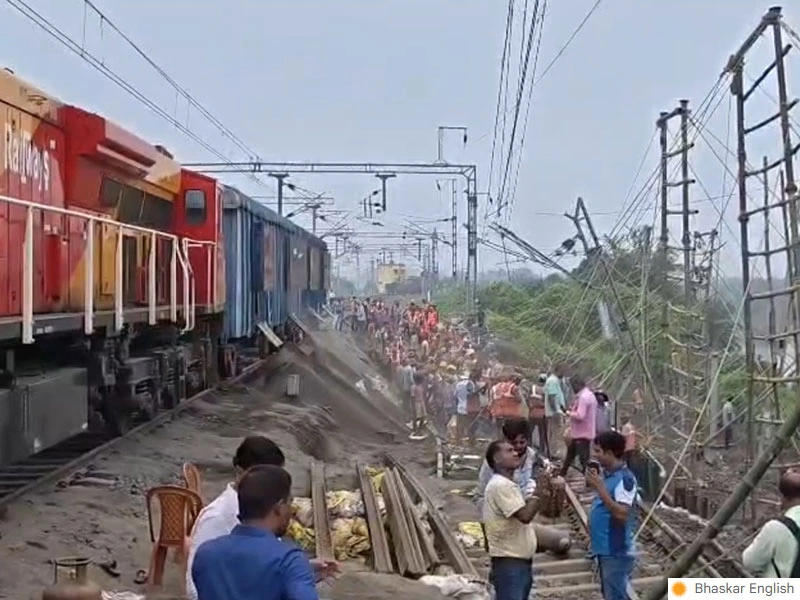
Farakka Track Collapse: Bengal’s Rail Line Hits a Wall Again
Farakka Track Collapse has exposed the deep-seated problem of Indian Railways. The Railways focus heavily on announcements of new high-speed trains and model stations. But their priority for repair and maintenance has fallen to the bottom. The rail link near New Farakka station has once again become a major problem for Bengal just a couple of days back. A section of the track has subsided after heavy monsoon rain, bringing main-line train services between Kolkata and North Bengal to a halt.
The affected stretch falls under the Eastern Railway’s Malda Division. Railway officials stopped train movement after a large portion of the track bed gave way. Reports from the site indicate that the ground beneath the concrete sleepers dropped by several feet. Running trains over such a damaged section would have created an obvious risk of derailment.
The disruption quickly spread across the network. Several important trains, including the Gour Express, Kanchankanya Express, Darjeeling Mail, and Padatik Express, were cancelled or diverted. Some services had to take much longer routes through Azimganj, Nalhati and Kiul.
The disruption hit passengers at the worst possible time. Those who reached the station with tickets in hand suddenly had to find another way to Kolkata or North Bengal. People reached stations expecting to board their usual trains and instead found cancellations, uncertainty and packed platforms. Howrah, Malda Town and Sealdah were among the stations where a large number of passengers were left looking for alternatives.
Road transport soon came under enormous pressure. Private buses on the Kolkata-Malda-Siliguri route began charging much more than usual. Tickets that normally cost around ₹600 reportedly crossed ₹1,500 in some cases. For someone travelling for medical treatment or depending on a daily wage, that is not a small increase. It can mean the difference between making the journey and staying back. But does a disease wait to spread its tentacles for disruption of Railways?
However, FM Bharat shows glimpses of hopes on Saturday that the trial run has started.
1. The Current Breakdown & Private Transport Exploitation
Railway engineers and workers moved equipment to the affected area after the washout. Heavy machinery and boulders were brought in, including material transported from Jharkhand. But repairing a badly damaged embankment is not as simple as filling a hole and reopening the line. The real problem became visible after the trains stopped.
Passengers who normally depend on the railway suddenly had to compete for seats on buses and other road transport. Buses operating between Jangipur, Farakka and Behrampore saw a sharp rise in demand. Reports of higher fares added another burden to people who had already been stranded for hours. I experienced this disruption myself. I took a night bus from Malda to Kolkata on September 4, and the ticket cost me more than ₹1,900 plus GST. That is an extraordinary amount for a journey that many regular train passengers make because it is affordable. A sudden rail breakdown should not turn an ordinary trip into a financial shock.
Government buses are running, but they too are struggling to handle the extra passengers. Baharampur-bound services are heavily crowded, with passengers packed into already busy buses. Some are travelling to Baharampur simply to catch local trains towards Sealdah or continue their journey by another route.
Farakka Track Collapse has caused a situation which is particularly difficult for elderly passengers, families with children and people travelling for medical treatment. A passenger who has a hospital appointment cannot simply wait another day because a railway embankment has collapsed. The disruption is not limited to passengers either. Freight movement has also taken a hit. Trucks carrying stone chips, coal and other goods are facing long delays on the highways. Fresh vegetables and other perishable goods are even more vulnerable because every additional hour on the road raises the possibility of damage and wastage.
The Farakka collapse is therefore not just a railway problem. It has pushed passengers, buses, freight operators and even medical travellers into the same narrow road network. A critical transport corridor has suddenly become dependent on whatever road capacity is available, which is quite insignificant and inconvenient.
2. The Ground Problem: Soil, Water and Heavy Loads
There is a basic geographical reason why this area requires special attention. Much of the land around Farakka, Tildanga and parts of Murshidabad consists of alluvial deposits associated with the Ganges system. Such ground can behave very differently when it becomes saturated with water. The Collapse is just another showpiece of the same history.
Heavy monsoon rain can weaken a railway embankment, particularly where drainage is inadequate or water remains close to the track. Once the soil loses strength, the embankment can settle, crack or move sideways.
That is where the problem becomes dangerous. The railway line carries both passenger and heavy freight traffic. Large freight trains carrying commodities such as coal and stone place considerable loads on the track and its supporting ground. If the underlying soil has already been weakened by water, repeated loading can make an unstable section even more difficult to manage. Right here, the Railway Administration has a bigger role to play. Is there any method of routine safety checks?
It would therefore be too simplistic to blame the Farakka Track Collapse on rain alone. Rain may trigger the immediate failure, but drainage, embankment condition, soil characteristics, nearby water bodies and the loads carried by the railway all deserve examination.
The problem is the Alluvial Soil. Water can weaken loose soil beneath an embankment. As a result, The ground may lose stability and settle. Prolonged saturation can reduce the strength of the soil. The constant Water Pressure also can cause the embankment to shift or sink. Another problem is Nearby Ponds and Drains. Overflow and water movement can erode the embankment edge. The result may be fatal as Part of the railway slope may give way.
The bigger concern is that this is not an entirely new type of problem for the Farakka corridor. Whenever a critical railway section becomes vulnerable during the monsoon, emergency repairs may restore connectivity, but the question of long-term stability remains. Reports that the embankment suffered another setback during restoration and testing only add to the concern. When repairs themselves encounter fresh ground movement, railway authorities have little choice but to extend cancellations and restrictions.
But the irony is, passengers bear the cost. People travelling to Kolkata for treatment can be left without a dependable route. Workers who live on daily earnings may lose a day simply because they cannot reach their destination. Families can spend hours at stations trying to understand whether their train will run. While travelling to Maldah, I faced the same problem. The Gour Express, which was supposed to reach Madah at 6 AM, finally reached at 4 PM on 3rd September. Will the Railways arrange to compensate for the losses, the people incur for these Railway delays? Now, we have got the double-engine Governments in the state and center. Will they seriously look into it?
And there is another concern that should not be ignored: overcrowding. When thousands of passengers suddenly gather at a few railway stations and bus terminals, crowd management becomes a safety issue. Footboard travel, packed buses and chaotic boarding are not merely inconveniences. One small incident in such a crowd can have serious consequences.
The Farakka corridor therefore needs more than another emergency repair. It needs a proper assessment of why these failures keep happening and what can be done before the next major monsoon spell. Otherwise, Farakka Track Collapse will keep on becoming the headline grabber, but the travelers will keep on suffering.
3. Why Dumping Boulders Is Not Enough
Boulders and ballast have an obvious role in emergency railway repairs. They can fill a damaged section, support the track and help engineers restore movement as quickly as possible. We must remember that an emergency repair and a permanent solution are two different things.
If the underlying soil has lost stability, simply adding large quantities of stone does not automatically solve the problem. The ground beneath the material still has to carry the load. If water continues to enter the embankment or wash material away from the sides, the same section can become vulnerable again. We will see the repeat telecast of the same urgent repairing, train cancellations and the commoners will keep on waiting in anxious faces.
That is why the long-term solution has to begin below the track rather than simply around it. Heavy rain has now become a routine incident. Will we have to suffer from such a serious fall out every time?
The exact engineering treatment should depend on a proper site investigation. Depending on the soil and drainage conditions, engineers may consider deeper foundations, piling, geotextile reinforcement, improved drainage, slope protection or retaining structures. Nearby ponds and drainage channels also need to be examined because water movement around an embankment can gradually remove supporting soil.
Such work is obviously more difficult than an emergency boulder operation. It may require a substantial traffic block and careful planning to prevent a prolonged shutdown of one of the most important rail links between South and North Bengal.
That operational difficulty cannot become an excuse for postponing permanent work indefinitely.
| Repair Approach | Purpose | Limitation |
|---|---|---|
| Emergency Ballast | Quickly supports and fills damaged sections | Does not necessarily address the weakness below the embankment |
| Improved Drainage | Moves rainwater away from the track and slope | Must be designed for extreme rainfall and surrounding water levels |
| Deep Reinforcement or Piling | Provides stronger support where the existing ground is inadequate | Requires detailed engineering work and longer traffic restrictions |
| Bank Protection | Reduces erosion along vulnerable edges and water bodies | Needs regular inspection and maintenance |
The uncomfortable question is why a railway corridor carrying so much passenger and freight traffic continues to become so vulnerable during heavy rain. Emergency teams deserve credit for responding quickly when a collapse occurs. But emergency response should not become the permanent maintenance strategy.
Indian Railways operates one of the country’s most important transport networks. A line connecting Kolkata with North Bengal carries passengers, goods, students, workers and patients every day. Its importance is far greater than the disruption visible at one station.
Bottom Line
The immediate priority is obvious: make the damaged section safe and restore train services. But reopening the line should not mark the end of the exercise.
The Farakka railway corridor needs a serious engineering review of its embankments, drainage systems, soil conditions and vulnerable stretches near water bodies. If the same locations repeatedly become unstable during the monsoon, emergency repairs alone are not enough. Passengers should not have to pay ₹1,500 or ₹1,900 for a journey that normally costs a fraction of that amount simply because a railway track has failed. Nor should patients, workers and families have to spend hours fighting through overcrowded buses after a predictable monsoon disruption.
The real test will come after the trains start running again. If the answer is simply to clear the tracks, dump more boulders and wait for the next monsoon, then the problem has only been postponed.
Farakka Track Collapse needs special attention and durable solution, not another temporary escape from the crisis.
See video coverage of the repair work here: Farakka Rail Line Collapse Video Update.
10 Key Takeaways:
- Farakka track collapse has disrupted the main rail connection between Kolkata and North Bengal after heavy monsoon rain damaged the track embankment.
- Several major trains, including Gour Express, Kanchankanya Express, Darjeeling Mail and Padatik Express, were cancelled or diverted.
- Thousands of passengers were left stranded at stations including Howrah, Malda Town and New Farakka.
- Private bus fares reportedly increased sharply, with some Kolkata-Malda-Siliguri tickets rising from around ₹600 to more than ₹1,500.
- A night bus journey from Malda to Kolkata on September 4 cost more than ₹1,900 plus GST, highlighting the financial burden on regular passengers.
- Government buses are also facing severe overcrowding as stranded railway passengers search for alternative routes.
- The disruption is affecting freight traffic as trucks carrying coal, stone and other goods face lengthy delays.
- Heavy rain, saturated alluvial soil, drainage problems, nearby water bodies and repeated heavy train loads may all contribute to embankment instability.
- Emergency boulder dumping can help restore train movement quickly, but it may not address the underlying weakness of the railway embankment.
- Indian Railways needs a long-term engineering solution for vulnerable sections around Farakka instead of relying repeatedly on temporary monsoon repairs.