
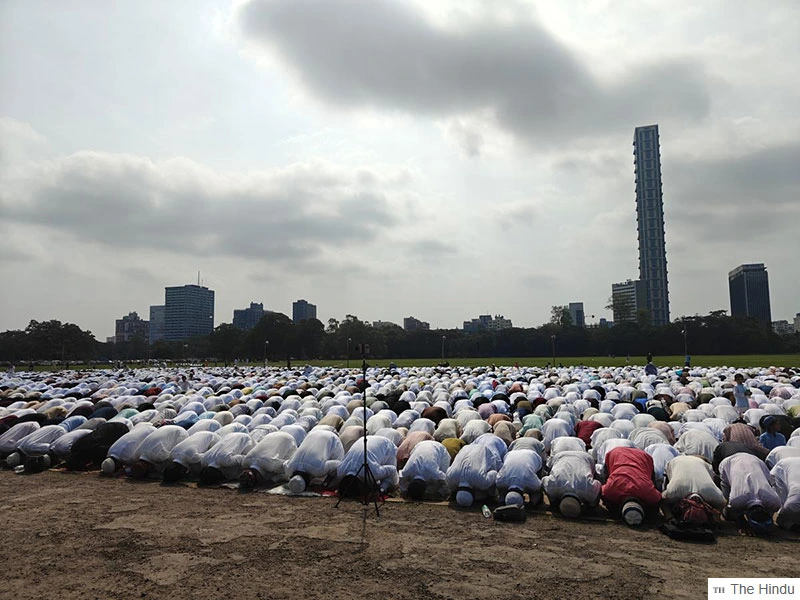
Does Eid Peace Prove Mamata’s Hidden Agenda?
The landmark achievement of Eid Peace during celebrations on May 28, 2026, marks a profound structural shift in West Bengal’s socio-political fabric. Historically, the previous administration routinely shut down major public thoroughfares in the heart of Kolkata to host massive religious congregations.
To justify this, state officials traditionally defended the practice by telling the public that blocking critical transit veins was absolutely essential. However, this year’s uninterrupted traffic has completely challenged the old claim that road closures are necessary for maintaining communal harmony.
However, the smooth, peaceful, and highly organized conduct of the Eid-al-Adha (Bakrid) prayers this year has completely exposed this narrative.
Following the paradigm-shifting West Bengal election results, the new administrative setup took a stern action. They immediately moved the primary venue away from busy city streets. So, this decisive action has fundamentally altered the public discourse around civic governance and minority engagement.
Rather, this massive relocation happened without a single incident of friction. Consequently, the total peace during the event has challenged long-standing political narratives across the state.
This historic transition provides undeniable evidence regarding the true nature of past administrative tactics. Above all, the flawless execution of the festival has effectively unmasked what analysts call Mamata’s Hidden Agenda.
This political strategy deliberately weaponized public inconvenience under the guise of religious freedom to consolidate a dedicated vote bank. By focusing heavily on symbolic gestures rather than structural growth, the former leadership regularly compromised the daily lives of ordinary citizens.
In contrast, the events of May 28 soundly prove a vital truth regarding modern civic management. Specifically, every community willingly cooperates to ensure a peaceful and progressive society. When leadership transparently prioritizes law, order, and public utility, everyone accepts.
Quick Comparison Table of EID 2026 and Earlier
| Aspect | 2026 Eid | Earlier Eids |
|---|---|---|
| Prayer Venue | Brigade Ground / Mosques | Red Road + streets |
| Road Usage | No road prayers | Common road prayers |
| Crowd Management | Shift system, controlled | Single large gatherings |
| Govt Approach | Strict regulation | Flexible |
| Sacrifice Rules | Regulated, certified | Looser |
| Market Activity | Reduced, expensive livestock | Vibrant & accessible |
| Traffic | Smooth | Disrupted |
| Overall Mood | Controlled / subdued | Festive / expansive |
Why Did the Red Road Shift Happen Without Any Friction?
For decades, Red Road served as the central focal point of Eid prayers in Kolkata. Because this critical arterial highway connects multiple sectors of the city, halting traffic on it inevitably triggered massive, city-wide gridlocks. Hence, these routine disruptions crippled local businesses, delayed emergency services, and stranded daily commuters for hours.
This year, the entire situation changed under the strict guidance of the new administration. They immediately enacted updated Kolkata Bakrid traffic rules. Thus, the vast congregation shifted seamlessly to the spacious Brigade Parade Ground. Consequently, thousands of worshippers gathered in comfort, while others offered prayers at local mosques across various districts of West Bengal.
The total absence of friction, protest, or public discontent stood out as the most remarkable aspect of this venue change. In fact, not a single community leader or common worshipper complained about the decision to keep Red Road completely open for regular traffic.
How Could Suvendu Make Eid So Peaceful?
The smooth transition currently dominates local Suvendu Adhikari news, highlighting several critical insights into how modern civic management can succeed when freed from political tokenism:
- Respect for Law and Order: Any community is fully prepared to adapt and show structural flexibility when the rule of law is applied uniformly and transparently.
- The Myth of Backlash: The political narrative that shifting long-standing habits would trigger immediate social unrest or hurt religious sentiments has been thoroughly debunked.
- Superior Logistics: Worshippers found the Brigade Ground to be highly spacious, well-coordinated, and far more accommodating for a large-scale spiritual gathering.
Organizing bodies like the Calcutta Khilafat Committee actively cooperated with local police forces to manage entry and exit points with high efficiency. Moreover, this level of institutional discipline proves a major point. The previous disruptions on Red Road never served as an organic requirement of the festival itself. Instead, the past administration politically manufactured this tradition to create a highly visible, segregated spectacle for electoral gains.
What Does This Change Reveal About Past Appeasement?
The total calm and order surrounding this year’s festival shed light on the deeper motivations behind the previous administration’s policy framework. Clearly, pure appeasement politics target electoral ballot boxes during crucial election cycles. Consequently, this superficial strategy fails to yield real, long-term socio-economic progress for the populace.
Furthermore, the previous government routinely treated minority communities as an isolated, uniform vote bank. Political circles often refer to this cynical approach as targeting a “milky cow“, referencing Mamata Banerjee’s own past remarks. Because of this mindset, the old leadership completely avoided doing the rigorous, structural work required for genuine empowerment.
An administration creates a deceptive illusion of support when it focuses entirely on symbolic, high-visibility concessions like blocking major thoroughfares. Meanwhile, this superficial approach leaves core developmental issues completely untouched.
Is It a Historical Shift in Governance?
This strategic diversion forms the core of the political framework that has now been challenged. To understand how the new, development-focused administration differs from the old model of appeasement-driven governance, consider the structural comparison below:
| Appeasement-Driven Governance (Old Model) | Development-Focused Administration (New Model) |
|---|---|
| Encourages public road disruptions to create visible political statements and show selective patronage. | Enforces clear thoroughfares and utilizes designated public grounds to ensure smooth communication for all. |
| Treats minority groups as a uniform vote bank, relying on emotional rhetoric and symbolic religious concessions. | Recognizes minority citizens as equal stakeholders, prioritizing modern education, infrastructure, and job creation. |
| Prioritizes symbolic, high-profile photo opportunities for top political leaders during religious events. | Prioritizes uniform civic rules, administrative neutrality, and institutional order across all communities. |
This comparative framework demonstrates that true progress cannot be achieved through temporary concessions that inconvenience the broader public.
The realization of Eid Peace without the traditional chaos proves that a society functions at its best when administrative policies protect religious freedom inside appropriate spaces without disrupting the collective economic life of the state.
Are The Literate Citizens Rejecting Token Vote Bank Politics?
The conventional narrative that minority populations blindly accept symbolic gestures from ruling parties is rapidly disintegrating across West Bengal. Educated youths, professionals, and community intellectuals have become increasingly vocal about their deep dissatisfaction with political tokenism.
If the Administration allows to block a road twice a year does absolutely nothing to improve literacy rates, health infrastructure, or employment opportunities within their neighborhoods.
Consequently, prominent minority political figures and social reformers like Naosad Siddique have repeatedly raised serious concerns. They loudly condemn the structural stagnation of the community under years of Trinamool Congress (TMC) rule.
For too long, high-decibel political participation in religious festivals by state leaders completely masked the real issues facing the population.
Specifically, this political theater hid the lack of modern technical institutes, poor bank credit linkages for small entrepreneurs, and substandard civic amenities.
Today’s generation is highly analytical. They look directly at national development indices, literacy gaps, and employment data rather than relying on emotional political speeches.
The widespread acceptance of the new venue at the Brigade Parade Ground shows a clear shift. Specifically, the educated demographic completely rejects the idea that the Government uses them as political tool. Instead, they strongly favor a progressive governance model that treats them as equal stakeholders.
Why Was the Chief Minister’s Absence So Politically Striking?
One of the most talked-about aspects of the May 28 celebrations was the complete absence of Mamata Banerjee at the main prayer venue. In previous years, the Chief Minister made a highly publicized, central ritual of attending the Red Road prayers. These appearances routinely featured a prominent stage presence, specific religious head coverings, and lengthy political speeches directed at the congregation.
This year, however, her participation was completely missing from the ground, limited only to routine, formal text greetings on social media platforms. This sudden and sharp withdrawal from the event raises several serious questions among political analysts and citizens alike:
- Electoral Disconnect: Did she choose to skip the event because the community’s voting patterns in the latest state assembly elections did not align with her party’s expectations?
- Calculated Political Utility: Did she realize that attending an orderly, well-regulated event inside a designated ground—rather than a disrupted public road—would no longer yield the high-visibility political dividends she desired?
- The Question of Invitation: Did the organizing committees intentionally not invite her, seeking to keep the sacred spiritual event completely free from partisan political rhetoric?
This shift highlights a welcome return to traditional administrative dignity in West Bengal.
Historic stalwarts of Bengal’s political landscape, such as former Chief Ministers Jyoti Basu and Buddhadeb Bhattacharya, maintained a strict line of demarcation between state administration and personal faith.
They consistently ensured top-tier security and infrastructure for all religious festivals, but they never felt the need to adopt specific religious garments or transform solemn prayer meets into personal political platforms.
The absence of political theatrics this year allowed the focus to remain exactly where it belonged: on devotion, peace, and spiritual reflection.
Is Shared Cultural Harmony Thriving Beyond Political Control?
Religion is a deeply personal relationship between an individual and the divine, but a festival is an inclusive celebration that belongs to the entire society.
The cultural history of West Bengal is rich with examples of organic, cross-community participation during major celebrations.
This beautiful, natural harmony has thrived for generations without requiring heavy-handed political engineering or manufactured administrative concessions.
During Durga Puja, individuals from every background, community, and belief system participate openly in visiting pandals, managing crowd logistics, and sharing in the cultural joy.
Similarly, during Christmas celebrations, the entire Park Street zone transforms into a vibrant hub of festivity where citizens of all faiths gather together to enjoy the illuminated streets and music.
In exactly the same spirit of shared heritage, Hindu households across Bengal regularly visit their Muslim neighbors and friends during Eid to share traditional food, exchange greetings, and strengthen local social bonds.
The monumental success of Eid Peace proves that genuine communal harmony does not depend on weak, rule-bending administrative policies. True unity thrives when the state guarantees equal protection under the law, maintains pristine civic order, and allows the natural, secular fabric of the society to celebrate its diverse traditions with mutual respect and dignity.
Major Festivals in West Bengal
| Festival Name | Month (Approx.) | Community | Key Features |
|---|---|---|---|
| Durga Puja | Sep–Oct | Hindu | Biggest festival; pandals, idol worship, cultural events |
| Poila Boishakh | April | Bengali (All) | Bengali New Year; new clothes, haal khata, feasting |
| Eid-ul-Fitr | Varies (Islamic) | Muslim | Prayer, charity (zakat), festive meals |
| Eid-ul-Adha | Varies (Islamic) | Muslim | Sacrifice ritual (qurbani), sharing food |
| Kali Puja | Oct–Nov | Hindu | Worship of Goddess Kali; night puja, fireworks |
| Saraswati Puja | Jan–Feb | Hindu (Students) | Worship of knowledge; popular among youth |
| Dol Jatra (Holi) | March | Hindu | Festival of colors; songs, dance (Basanta Utsav) |
| Lakshmi Puja | Oct | Hindu | Home puja for wealth; alpona decorations |
| Jagaddhatri Puja | Nov | Hindu | Popular in Chandannagar; lighting displays |
| Poush Mela | Dec | Cultural/Folk | Baul music, handicrafts, rural fair |
| Christmas | December | Christian (All) | Park Street lights, midnight mass, celebrations |
How Should the New State Government Proceed from Here?
The orderly and successful management of the May 28 festival offers a flawless, highly effective blueprint for the new state administration moving forward. The government must remain firmly committed to a policy of uniform civic discipline, prioritizing economic modernization over divisive identity politics.
To maintain this positive momentum, the state should focus on three core administrative pillars:
- Enforce Clear Thoroughfares: Establish a strict, permanent policy across all districts stating that no religious, political, or social event will be permitted to block busy city roads, highways, or vital public transit lines.
- Provide Dignified Spaces: Ensure that the local administration always provides spacious, secure, and well-equipped alternative grounds (like the Brigade Parade Ground) so that all communities can celebrate their festivals with complete safety and structural dignity.
- Invest in Real Empowerment: Redirect state funds and administrative focus away from superficial tokenism and toward establishing high-quality schools, technical universities, modern healthcare centers, and robust job opportunities in underdeveloped areas.
At the end, ease of communication, reliable infrastructure, and uniform laws are the fundamental requirements of a progressive, modern society.
For a detailed look at how worshippers adapted to and appreciated the highly organized arrangements at the new venue, you can view the complete field report covering the Bakrid 2026 Celebrations in Kolkata.
By permanently moving past the archaic era of vote bank appeasement, West Bengal can finally unlock its true potential and build a prosperous future grounded in equity, mutual respect, and lasting social peace.
10 Key Takeaways
- Eid Peace arrived smoothly on May 28, 2026. This happened primarily because the new administration shifted the main prayer venue away from busy public streets.
- Consequently, thousands of worshippers gathered comfortably at the spacious Brigade Parade Ground and inside local mosques.
- Surprisingly, no community groups or citizens complained about losing access to the traditional Red Road venue.
- This seamless transition directly exposes Mamata’s Hidden Agenda, which previously used public disruptions to secure a dedicated vote bank.
- In fact, the total lack of friction proves that pure appeasement policies build electoral power rather than real community development.
- Meanwhile, educated minority citizens are actively rejecting token gestures, demanding modern infrastructure and real economic opportunities instead.
- Therefore, prominent community leaders like Naosad Siddique are loudly calling for an end to superficial political exploitation.
- Surprisingly, Mamata Banerjee completely skipped the main event this year, highlighting a sharp decline in her expected political dividends.
- Instead, the event restored traditional administrative dignity by focusing entirely on peaceful devotion rather than political stagecraft.
- Above all, this success provides a clear blueprint for the government to permanently prioritize clear thoroughfares, uniform laws, and genuine social growth.
People Also Ask (PAA)
Why Did the Administration Shift Away Eid prayers from Red Road in 2026?
The newly elected state government, led by Chief Minister Suvendu Adhikari, implemented a strict administrative policy. Specifically, this directive banned all large-scale religious and social events from blocking public roads and arterial highways. Simultaneously, the change aimed to eliminate traffic gridlocks and minimize public inconvenience in central Kolkata.
Where was the primary Eid-al-Adha congregation held instead?
The new administration successfully relocated the main morning prayers to the spacious Brigade Parade Ground. In tandem with this shift, other major gatherings took place at designated open fields like Park Circus Maidan.
Simultaneously, thousands of worshippers congregated inside traditional venues like the Nakhoda Mosque. Consequently, these highly organized logistical choices kept the surrounding municipal roads entirely clear for vehicular movement throughout the city.
How did the Muslim community react to the venue change?
The transition occurred peacefully and smoothly with zero reported public friction. In fact, organizing bodies like the Calcutta Khilafat Committee and local political leaders publicly thanked the police and civic administration. They explicitly praised the authorities for delivering structured logistical arrangements and a highly secure layout at the Brigade Ground.
Was the change applied to all roads across Kolkata?
Yes, the enforcement was uniform across traditionally congested pockets of the city, including major thoroughfares like Rajabazar also. Aerial drone surveillance and massive police deployments ensured that public traffic flowed completely uninterrupted throughout the morning prayer hours.