
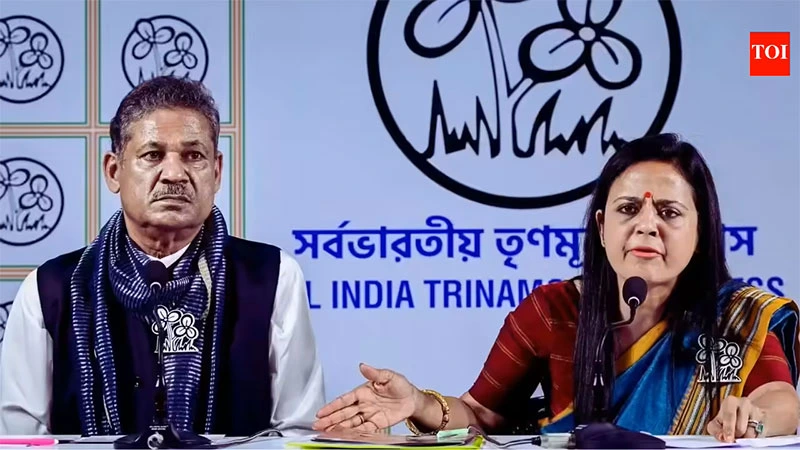
Can Mahua Moitra represent Bengali Asmita (বাঙালি অস্মিতা) through political rhetoric?
Bengali Asmita (বাঙালি অস্মিতা) is a fascinating concept, yet most Bengalis take pride in their past rather than the present. Although Mamata Banerjee and the Trinamool Congress frequently use “Bengali Pride” to label the BJP as outsiders (বহিরাগত), voters see through this political strategy ahead of the 2026 West Bengal elections.
However, Mahua Moitra’s recent comments on March 28 sparked a massive political storm because she unnecessarily insulted the Gujarati community.
Her attempt to belittle Gujarat’s role in the freedom struggle shows a deep lack of historical knowledge. Can any one expect such behavior from a former Vice President of JPMorgan?
Though it seems typical within the Trinamool Congress culture. In that environment, verbal abuse and spreading misinformation often help a leader climb the political ladder.
This raises a bigger question: Is Mahua Moitra herself a true Bengali, or does she believe wearing a saree is enough to represent the culture?
Is Bengali Asmita Being Used to Label BJP as Outsiders ?
The debate around Bengali Asmita has intensified in recent political discussions. Many believe that Trinamool Congress uses this narrative strategically to label BJP as outsiders.
However, history and ground realities present a broader and more inclusive picture of Bengal’s identity.
Outsider (বহিরাগত) Label
- Firstly, the idea of promoting “Bengali Asmita” (বাঙালি অস্মিতা) seems to be a way to tag the BJP as an outsider (বহিরাগত) party.
- Moreover, since leaders like Narendra Modi and Amit Shah are from Gujarat, critics argue that this narrative sometimes leads to unfair criticism of Gujaratis.
- Meanwhile, the BJP appears to have adjusted its strategy after 2021. Specifically, the party is now focusing more on local leadership and grassroots presence in its campaigns of 2026 Assembly Election in Bengal.
- Finally, it is important to note that national parties naturally involve central leaders in campaigns. When a national leader campaigns in a state, the “Outsider” (বহিরাগত) label is rarely a neutral observation; it is almost always a deliberate narrative tool that shows the regional parties’ desperation to protect a local political monopoly.
Bengal’s Cultural Heritage
- However, Bengal’s history tells a very different story. Even after independence and during the time of the two-nation theory, West Bengal largely upheld a culture of coexistence and inclusivity.
- Bengali Asmita (বাঙালি অস্মিতা) could never affect this coexistence and cohesiveness.
- In fact, people from multiple communities like Hindus, Muslims, Sikhs, Christians, and those with Arabic and Persian roots, have lived together peacefully. Not only in Kolkata but also across rural Bengal, this diversity has been a defining feature.
- Furthermore, families from states like Bihar, Rajasthan, Odisha, Punjab, and Gujarat have been living in Bengal for generations. Therefore, Bengal’s identity has always been inclusive rather than exclusive.
- Interestingly, there have been public sentiments highlighting Bengal’s peace. For example, during the tenure of Jyoti Basu, people often credited leadership for maintaining communal harmony, reinforcing the idea that Bengal is safe for all.
- A statement from a Sikh in a drunk condition reveals the impeccable track record of Bengal in communal harmony. Conversation was like “Why don’t riots happen in West Bengal?” The answer: “because the government doesn’t want them to“.
Outsiders Label to build Political Optics
- On the other hand, political contradictions also emerge. For instance, some leaders may label certain individuals as “Bengali”, but the public may still see them based on their regional origins. This shift raises questions about how people define identity in practice.
- In addition, critics question whether symbolic actions, such as visiting constituencies occasionally or organizing grand events can’t be enough to represent true cultural belonging or connection.
- Public figures often become symbols in the tug-of-war between authenticity and political convenience. This tension typically arises when a person’s identity is highlighted or “adopted” to serve a specific electoral or social narrative.
- The use of iconic cultural figures as political props often creates a friction point between mass mobilization and cultural sanctity. When leaders like Anubrata Mondal or any political figure incorporate revered symbols into their public displays, the reaction often splits along lines of intent and execution.
Keynotes on usage of Bengali Asmita (বাঙালি অস্মিতা) to label BJP as outsider (বহিরাগত)
In short, the discussion around Bengali identity and political narratives highlights a deeper issue of inclusivity versus political strategy. While identity can be a source of pride, Bengal’s true strength lies in its diversity and acceptance. Therefore, instead of using identity to divide, a more balanced and historically grounded approach can help maintain unity and mutual respect.
Moreover, Mahua Moitra made this comment in Bhabanipur, which is going to witness the high-voltage battle between Mamata Banerjee and Suvendu Adhikary in Bengal Elections 2026.
Has Mahua Moitra tried to turn History Selectively in Political Narratives?
Recent political remarks have sparked debate about history, identity, and the role of facts in public discussions. While emotional narratives can be powerful, they often raise important questions about accuracy and fairness, especially when discussing India’s freedom struggle.
Cellular Jail Rhetoric
- Firstly, the claim that a large percentage (68%) of prisoners in the Cellular Jail (Kala Pani) were Bengali has created confusion.
- However, even if such a statistic is true, it does not mean that only those imprisoned there were freedom fighters.
- In fact, many iconic leaders of India’s independence movement never went to the Cellular Jail. For example, Mahatma Gandhi, Jawaharlal Nehru, Sardar Vallabhbhai Patel, Subhash Chandra Bose, Bhagat Singh, and Bal Gangadhar Tilak all played crucial roles in the struggle for independence.
- Therefore, defining the freedom movement based on a single location or experience can lead to a narrow and misleading interpretation of history. Oppositions sees Moitra’s remarks as a display of “narrow regional chauvinism“.
Freedom Fighters from Gujarat
- Moreover, when discussing Gujarati freedom fighters, several important names come forward. Leaders like Mahatma Gandhi and Sardar Vallabhbhai Patel were central figures in shaping India’s independence.
- In addition, other notable personalities such as Kasturba Gandhi, Shyamji Krishna Varma, Abbas Tyabji, and Indulal Yagnik also made significant contributions to the freedom movement.
- Consequently, ignoring or downplaying such figures may reflect a lack of historical balance in public statements.
- At the same time, it is important to acknowledge that not everyone may have deep expertise in history. However, speaking on sensitive topics without proper knowledge can lead to controversy and criticism.
Regional Parties vs National Parties
- Furthermore, critics argue that regional political parties sometimes focus heavily on localized identity politics, which may result in narrow narratives.
- For instance, attempts to expand political influence into states like Meghalaya, Goa, Tripura, Assam, Arunachal Pradesh, and Manipur have faced challenges. As a result, some observers believe that strengthening regional identity narratives becomes a strategic necessity.
- Finally, the repeated use of the “outsider” label in politics raises a broader question about intent. Is it a genuine concern, or is it a calculated political approach to influence voters before 2026 Bengal Elections?
Keynotes on Distortion of History for narrow political interest
To Summarize, discussions about history and identity should be rooted in facts and inclusivity rather than selective narratives.
India’s freedom struggle was a collective effort involving people from all regions and communities.
Therefore, a balanced understanding of history, along with responsible political discourse, is essential to maintain unity and respect across the nation.
Is the Idea of ‘Outsider’ (বহিরাগত) Applied Selectively in Politics?
The ongoing debate around identity, politics, and governance in West Bengal continues to raise important questions. Many people are now asking whether identity is being applied consistently or selectively, especially when it intersects with business, tragedy, and political response.
When Indian tennis icon Leander Paes officially joined the Bharatiya Janata Party (BJP) on March 31, 2026, he becomes an outsider.
What About the Business Magnets?
- Firstly, questions arise about consistency. For instance, does Mamata Banerjee have got the guts to label the prominent business figures like Sanjiv Goenka, the Bangur family, the Dalmia family, the Kanoria family, or Harsh Neotia as outsiders? Or she applies such labels selectively?
- Moreover, some critics argue that economic contribution, such as paying taxes in Bengal or participating in financial instruments like electoral bonds, may influence how individuals are perceived or accepted within the state.
Root of Sufferings of Bengali Migrant Workers
- At the same time, the rise in identity-based rhetoric has also been linked to recent tragic incidents. For example, the deaths of two individuals in Samserganj have intensified emotional and political reactions.
- Furthermore, concerns have been raised about the safety of migrant workers from Bengal. When they travel to other states for work, reports of harassment or violence sometimes emerge, creating fear and resentment.
- In addition, critics have questioned the role of law enforcement during sensitive incidents. Allegations of inaction or delayed response of Police have lead to public distrust and possible backlash.
- However, it is also important to note that such incidents didn’t take places only in one region or political party. Similar cases have happened in states like Kerala, Tamil Nadu, and Punjab, indicating a broader national issue.
- Meanwhile, political reactions often include protests and public demonstrations. While these actions can raise awareness, some observers believe they may also turn into political spectacles rather than leading to concrete solutions.
- Therefore, a key question remains: has the government taken effective administrative steps? For example, could we notice policy discussions, official meetings, or structured interventions to address these issues?
- Additionally, critics raise questions sometimes about the role of public figures and their personal influence.
- Whether individuals connected to leadership take active steps toward resolution is also part of the broader debate.
- Finally, critics suggest that leaders with a background in grassroots or street politics may rely more on public mobilization and visibility to maintain political relevance.
Keynotes on selective labeling of outsider as politics of optics
Overall, the debate highlights the need for consistency, accountability, and meaningful action in politics. Identity should not be applied selectively, and serious issues require more than symbolic responses.
Ultimately, transparent governance, equal treatment, and practical solutions are essential to build trust and ensure justice for all citizens.
Will the 2026 Bengal Elections Mark the End of Mamata Banerjee’s Era in Bengal?
The 2026 West Bengal Assembly election is shaping up to be a unique chapter in the state’s history. Although Mamata Banerjee remains the dominant face of Bengal politics due to a lack of a strong opposition leader, the public is now demanding real answers. Consequently, leaders like Mahua Moitra should stay alert.
History proves that the people of Bengal know how to humble powerful leaders; they previously taught a lesson to Indira Gandhi and ended 34 years of Left Front rule.
Therefore, many now wonder if the final days of Mamata Banerjee’s political dominance have finally arrived.
10 Key Takeaways:
- Bengali Asmita (বাঙালি অস্মিতা) is often used as a political tool, especially to label BJP as outsiders (বহিরাগত).
- Bengal’s enriched history reflects inclusivity and coexistence, not narrow regionalism.
- Selective use of history can create misleading political narratives.
- India’s freedom struggle was a collective effort across all regions, irrespective of narrow regional groups.
- Comments perceived as disrespectful toward any community can trigger major political backlash.
- The idea of “outsider” (বহিরাগত) is often applied inconsistently, especially in politics and business.
- Recent incidents and governance issues have raised questions about law, order, and accountability.
- Political responses sometimes focus more on public optics than real solutions.
- The 2026 West Bengal election is shaping into a crucial and possibly transformative event.
- Ultimately, voters hold the power and may drive significant political change based on performance.
People Also Ask (FAQ):
1. What is meant by Bengali identity in politics?
Bengali Asmita (বাঙালি অস্মিতা) in politics refers to the use of culture, language, and history to connect with voters. However, Mamata Banerjee and Trinamool Congress use it sometimes strategically to influence public opinion.
2. Why is the “outsider” (বহিরাগত) narrative important in West Bengal politics?
The “outsider” narrative is often used to position certain parties or leaders as disconnected from local culture, especially during elections.
3. Is Bengal historically inclusive?
Yes, Bengal has a long history of cultural diversity and coexistence, with people from different religions and regions living together peacefully.
4. Did only Bengalis contribute to India’s freedom struggle?
No, India’s freedom movement was a collective effort involving leaders and communities from all across the country.
5. Why do political statements about communities create controversy?
Such statements can be seemingly disrespectful or inaccurate, leading to public backlash and political debates.
6. Are “outsider” labels applied consistently in politics?
Not always. Critics argue Trinamool Congress uses these labels selectively based on political convenience.
7. What issues are voters in West Bengal concerned about today?
Voters are increasingly focusing on governance, safety, accountability, and economic opportunities.
8. How this strong Bengali Ashmita is affecting the migrant workers from Bengal?
Some migrant workers face challenges and safety concerns in other states, which has become a political issue.
9. Why is the 2026 West Bengal election important?
It seems as a potential turning point, where voters may demand stronger accountability and leadership.
10. Can political power change in West Bengal?
Yes, history shows that voters in Bengal can bring significant political change when they feel the need.